ERP Consulting & Implementation for HVAC & Mechanical Contractors in Canada
How Canadian HVAC and mechanical contractors choose and implement ERP systems built for job costing, dispatch, and profitable project delivery.
Quick Summary
ERP implementation for HVAC and mechanical contractors centers on job costing accuracy, field service dispatch integration, WIP reporting, and inventory tracking — mechanics that generic accounting software doesn't handle well. Implementation typically costs $30,000-$150,000 for small to mid-sized companies and takes three to six months. This guide covers what to look for, platform options, and how to plan a successful implementation.
Table of Contents
- Why ERP Matters for HVAC & Mechanical Contractors
- Core ERP Requirements for This Industry
- Job Costing: The Foundation of Profitability
- Field Service Dispatch Integration
- WIP Reporting & Progress Billing
- ERP Platform Options for This Industry
- Cost & Timeline Expectations
- The Implementation Process
- Common Implementation Mistakes to Avoid
- How Arbutus MC Supports Contractors
- Frequently Asked Questions
- Conclusion
1. Why ERP Matters for HVAC & Mechanical Contractors
HVAC and mechanical contractors run a business model that generic accounting or bookkeeping software simply wasn't built for. Revenue comes from a mix of service calls, maintenance contracts, and larger installation or construction projects — each with different costing, billing, and margin dynamics. Technicians in the field need real-time access to job information, while the back office needs accurate job costing data flowing in from every truck roll and material purchase.
Without a proper ERP system tying these pieces together, contractors typically end up with disconnected tools — a dispatch app, a separate accounting system, and a spreadsheet trying to bridge the two — that create constant reconciliation work and, more importantly, hide which jobs and service lines are actually profitable.
A well-implemented ERP system solves this by connecting field operations directly to financial reporting, giving owners real visibility into job-level profitability, technician efficiency, and overall business performance — without the manual data wrangling that generic software leaves behind.
Evaluating an ERP System for Your Contracting Business?
Book a free 30-minute discovery call and we'll talk through what platform fits your operation's scale and complexity.
2. Core ERP Requirements for This Industry
- Job costing by project and service call: Real costs tracked against estimates, by job and by cost category
- Field service dispatch integration: Technician scheduling, work orders, and time tracking connected to the financial system
- WIP reporting: Progress billing tracking for larger installation and construction projects
- Inventory & equipment tracking: Parts, materials, and equipment costs tied accurately to specific jobs
- Mobile access for technicians: Field-ready tools for time entry, material usage, and job documentation
- Service contract management: Recurring maintenance agreement tracking and renewal billing
These requirements go well beyond what standard small business accounting software supports natively, which is why industry-specific ERP or construction-focused platforms tend to serve this sector far better than generic alternatives.
3. Job Costing: The Foundation of Profitability
| Cost Category | What It Tracks | Why It Matters |
|---|---|---|
| Labor | Technician hours by job, including travel time | Often the largest cost category and most prone to underestimation |
| Materials & Equipment | Parts, units, and equipment allocated to specific jobs | Accurate tracking prevents margin erosion from material waste or misallocation |
| Subcontractor Costs | Costs from specialty trades brought in on larger projects | Needs clear allocation to avoid blended, inaccurate job costs |
| Overhead Allocation | Shared costs distributed across active jobs | Reveals true profitability once indirect costs are properly accounted for |
Without accurate, real-time job costing, contractors often don't discover that a job lost money until well after it's complete — by which point the information is useful for future bidding, but too late to correct course on that specific project.
4. Field Service Dispatch Integration
Illustrative Time Savings From Dispatch-ERP Integration
Illustrative example only — actual time savings depend on company size, call volume, and existing process maturity.
- Technician time and material usage flow directly into job costing without manual re-entry
- Real-time job status visibility supports better scheduling and dispatch decisions
- Automated invoicing triggers based on completed work orders, speeding up billing cycles
- Historical job data becomes available for more accurate future bidding
5. WIP Reporting & Progress Billing
For HVAC and mechanical contractors handling larger installation or construction projects, work-in-progress (WIP) reporting becomes just as important as it is for general contractors — comparing costs incurred, billings to date, and estimated total cost to reveal overbilling or underbilling on active projects.
- Percentage of completion tracking: Costs incurred against estimated total project cost
- Progress billing schedules: Milestone-based invoicing tied to actual project completion
- Change order integration: Scope changes reflected accurately in both cost and contract value
- Underbilling alerts: Early warning when billing falls behind actual completed work
Contractors managing multiple concurrent projects should review our detailed WIP reporting guide for Canadian general contractors for a deeper look at how percentage-of-completion accounting works in practice.
Struggling With WIP Visibility Across Active Jobs?
We'll help you build reporting that shows exactly which projects are on track and which aren't.
6. ERP Platform Options for This Industry
| Platform Type | Examples | Best Suited For |
|---|---|---|
| Construction-Focused ERP | Sage 300 Construction, Foundation Software | Contractors with heavy project/job costing needs |
| Field Service Management + Accounting | ServiceTitan, Jobber paired with QuickBooks/Xero | Service-heavy HVAC businesses with lighter project work |
| Mid-Market Cloud ERP | NetSuite, Acumatica | Growing companies needing integrated financials and operations |
| Enterprise ERP | SAP, Oracle | Large, multi-division mechanical contracting firms |
Many smaller and mid-sized HVAC contractors find success pairing a dedicated field service management tool with a cloud accounting platform through integration, rather than committing immediately to a full enterprise ERP — this approach costs less and can be implemented faster while still solving the core job costing and dispatch integration problem.
7. Cost & Timeline Expectations
| Company Size | Estimated Implementation Cost (CAD) | Typical Timeline |
|---|---|---|
| Small (under 20 employees) | $30,000 – $70,000 | 3-4 months |
| Mid-sized (20-75 employees) | $70,000 – $150,000 | 4-6 months |
| Large (75+ employees, multi-division) | $150,000 – $400,000+ | 9-12+ months |
Costs include software licensing, implementation partner fees, data migration, and staff training — and, as with any ERP project, migrating historical job costing data accurately is often the most time-consuming part of the process.
8. The Implementation Process
- Requirements assessment: Documenting current workflows and specific job costing, dispatch, and billing needs
- Platform selection: Evaluating options against documented requirements and budget
- Data migration planning: Historical job, customer, and financial data mapped for accurate transfer
- Configuration & customization: System configured for specific job costing structures and reporting needs
- Staff training: Both office and field staff trained on new workflows
- Parallel run & go-live: Running old and new systems briefly to confirm accuracy before full cutover
9. Common Implementation Mistakes to Avoid
- Choosing a platform based on price alone without confirming job costing depth
- Underestimating field staff training time and resistance to new mobile workflows
- Migrating incomplete or inaccurate historical job cost data
- Failing to configure overhead allocation methodology before go-live
- Not involving field technicians in requirements gathering, leading to poor adoption
- Underbudgeting for ongoing system administration and support post-implementation
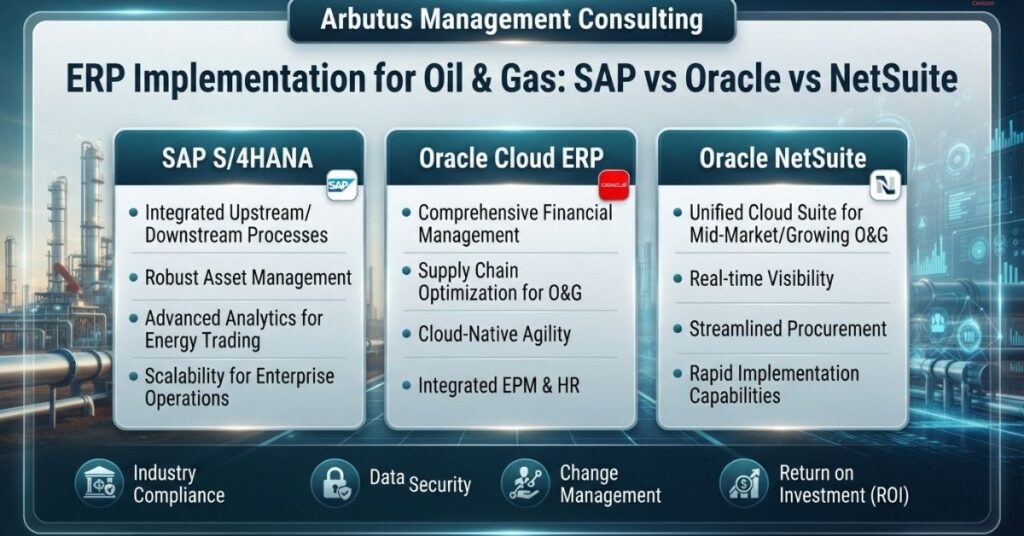
Businesses evaluating similar technology investments in other capital-intensive sectors may find our ERP implementation comparison for oil & gas companies useful for understanding how platform-fit decisions scale with company complexity, and our cash flow optimization framework for how better financial visibility supports growth decisions like this one.
10. How Arbutus MC Supports Contractors
Arbutus Management Consulting works with Canadian HVAC and mechanical contractors to evaluate ERP fit and build the financial processes that support a successful implementation. Our support typically includes:
- Business Planning & Financial Modeling — implementation cost-benefit analysis and job costing structure design
- Fractional CFO Services — strategic financial oversight through the implementation process
- Bookkeeping & Administration — clean historical data supporting smoother ERP migration
- Financial Modeling for Non-Profits & Charities — for organizations with mechanical trades training or community components
Whether you're evaluating your first ERP investment or looking to upgrade a system that's fallen behind your business's growth, our team helps assess the real cost-benefit tradeoffs across platform options based on your specific job costing and dispatch needs — not generic vendor comparisons. Contractors weighing expansion decisions may also find our business planning guide for fitness and gym chains useful as a related example of capital-intensive growth planning, and our fractional CFO services overview for how ongoing strategic support fits alongside a major system investment like this one.
Ready to Build an ERP Strategy That Fits Your Business?
Talk to our team about evaluating ERP options for your HVAC or mechanical contracting business.
11. Frequently Asked Questions
What should an HVAC or mechanical contractor look for in an ERP system?
HVAC and mechanical contractors should look for an ERP system with strong job costing capability, integration with field service dispatch and scheduling, WIP reporting for progress billing, inventory and equipment tracking, and mobile access for technicians in the field.
How much does ERP implementation cost for an HVAC contractor?
ERP implementation costs for HVAC and mechanical contractors typically range from roughly $30,000 to $150,000 for small to mid-sized companies, depending on the platform chosen, number of users, and level of customization required for job costing and dispatch integration.
What is the difference between field service management software and a full ERP?
Field service management software focuses on scheduling, dispatch, and technician workflows, while a full ERP integrates that operational data with core financial functions like job costing, WIP reporting, and general ledger accounting, giving a complete view of both operations and financial performance.
Can small HVAC contractors benefit from ERP software, or is it only for large companies?
Small HVAC contractors can benefit significantly from ERP software, particularly cloud-based mid-market platforms designed for smaller teams, since even modest improvements in job costing accuracy and dispatch efficiency can meaningfully improve profitability at any company size.
How long does ERP implementation take for a mechanical contracting company?
ERP implementation for mechanical contracting companies typically takes three to six months for small to mid-sized companies using cloud-based platforms, though larger companies with complex multi-division operations may require nine to twelve months or longer.
12. Conclusion
For Canadian HVAC and mechanical contractors, the right ERP system does far more than replace a spreadsheet — it connects field operations directly to financial reporting, revealing which jobs, service lines, and technicians actually drive profitability. Getting the implementation right means prioritizing job costing depth, dispatch integration, and WIP reporting capability over brand recognition alone, and planning realistically for the data migration and training effort a successful rollout requires. Contractors who invest in this properly consistently gain the operational and financial visibility needed to bid more accurately and grow more profitably.
In Short
ERP implementation for HVAC and mechanical contractors requires strong job costing, field service dispatch integration, and WIP reporting capability — typically costing $30,000-$150,000 and taking three to six months for small to mid-sized companies. Choosing the right platform depends on job complexity and existing workflows, not brand alone. Arbutus MC helps Canadian contractors evaluate ERP fit and build the financial processes to support a successful implementation.
Let's Talk About Your ERP Evaluation
Book a free discovery call, send us an email, or give us a call — we'll help you make a confident, well-supported decision.