Startup Funding Conditions for Canadian Founders 2027
What the latest venture data, government programs and lending conditions mean for Canadian founders planning to raise in 2027, and how to prepare a plan, model and funding stack that investors will back.
Quick Summary
Heading into 2027, Canadian startup funding is available but selective. CVCA data shows about $4.3 billion across 397 venture deals in the first nine months of 2026, with the lowest deal count for the period since 2021, a 55% drop in growth-stage investment and capital concentrated in a few large rounds. Founders who plan longer runway, use non-dilutive and debt sources wisely and bring investor-ready models will be best placed to raise.
Where Funding Stands Entering 2027
The headline numbers look stable, but the details tell a more difficult story. The Canadian Venture Capital and Private Equity Association (CVCA) reported that Canadian companies raised about $4.3 billion across 397 venture capital deals in the first nine months of 2026, roughly 1% below the same point in 2025. As reported by The Logic, both dollars and deal count were at their lowest levels for the period since 2021.
Capital is concentrated. Early in 2026 the first quarter saw about $936 million across 104 deals, the lowest quarterly deal count since 2017, with pre-seed through early-stage companies receiving nearly 70% of dollars and only one growth-stage deal. For the first half of the year, 16 financings accounted for nearly 60% of all dollars, and in Q3 six deals accounted for 59% of investment. Another data tracker reported that U.S. investors provided about 64% of dollars invested in Canadian startups in the first nine months, the highest share since 2017.
The growth-stage gap is especially concerning. BetaKit reported that growth-stage investment through the first three quarters was about $396 million, down 55% from the same point last year. That means companies reaching Series B and beyond often face a thin domestic market and must look abroad. Founders should plan for that reality now.
Planning to raise in 2027?
Book a free discovery call to review your runway, financial model and funding strategy.
Capital concentration in Canadian venture capital (share of dollars)
Sources: CVCA data as reported by The Logic and BetaKit. Figures are rounded and use different deal-size definitions by period.
Growth-stage venture investment, first nine months (prior year = 100)
Source: CVCA Q3 2026 data as reported by BetaKit (about $396 million in 2026); index derived from the reported decline.
Conditions by Funding Stage
| Stage | Current conditions | What founders should do |
|---|---|---|
| Pre-seed and seed | Early-stage companies still receive a large share of dollars, but deal counts are down and investors want traction | Show customer evidence, a clear milestone plan and 18 to 24 months of runway |
| Series A | Selective; investors look for retention, efficient growth and a repeatable sales motion | Present cohort data, unit economics and a realistic path to the next round |
| Growth and Series B+ | Scarce domestically; growth-stage dollars fell 55% in 2026 and U.S. investors dominate | Build relationships with U.S. and strategic investors early; consider venture debt and revenue-based options |
| Venture debt and credit | Venture debt reached a record in 2025, and lenders favour recurring revenue | Use selectively after equity, with covenant headroom |
| Non-dilutive funding | SR&ED remains strong; several provincial and federal programs are changing | Confirm current intake before including grants in a plan |
Five Shifts Shaping 2027
- Concentration in fewer, larger deals. A small number of rounds takes most of the dollars, leaving a smaller pool for everyone else.
- The growth-stage gap. Companies that outgrow seed and Series A struggle to find domestic lead investors. CVCA has pressed Ottawa for support, and the federal Growth VCCI is expected to take 12 to 18 months for capital to reach fund managers once details are announced.
- U.S. investor dominance. American investors now provide most dollars in some trackers, which raises questions about ownership, governance and where companies end up.
- M&A as the main exit. CVCA reported that 26 of 28 venture-backed exits in the first three quarters of 2026 were acquisitions, so planning for a strategic sale matters.
- AI and software capture the lion's share. Information and communications technology, including AI, attracted about 65% of deals in the first half of 2026, which can make other sectors work harder to raise.
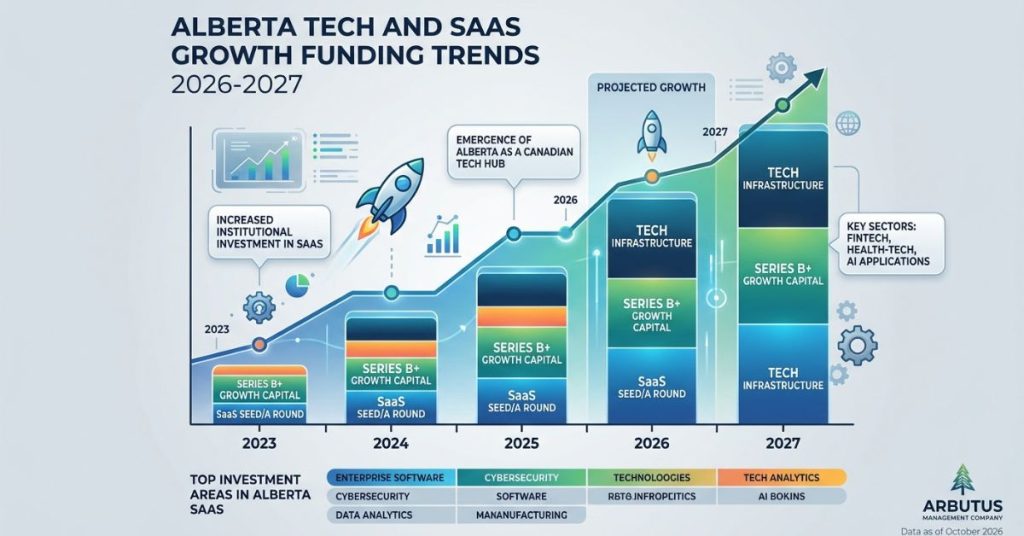
Our post on Alberta tech and SaaS growth funding trends explains how these themes show up regionally, including the roughly $706 million raised across 85 Alberta deals in 2024.
Non-Dilutive Funding and Government Programs
Non-dilutive money extends runway without giving up equity, but it is not guaranteed and rarely arrives quickly.
| Source | What it offers | Planning notes |
|---|---|---|
| SR&ED tax credits | Credits and refunds on eligible R&D; the enhanced limit for CCPCs rose from $3M to $6M in Budget 2025 | Model conservatively; refunds arrive after filing |
| NRC IRAP | Advisory services and non-repayable contributions for SME innovation, including cleantech funding formerly delivered by SDTC | Competitive and milestone-based |
| Alberta Innovates | R&D and commercialization support in Alberta | Stopped accepting new applications to six startup and SME programs on May 29, 2026; confirm redesigned intake |
| Provincial and sector programs | Grants and cost-sharing for specific industries, such as Emissions Reduction Alberta for emissions technology | Often reimburse after spending |
| Development lenders | BDC and similar lenders provide loans and venture capital | Require detailed plans and projections |
- Do not rely on a single program for runway.
- Model grants as reimbursements after eligible spending, with cost-sharing.
- Prepare application materials early. See our grant application readiness checklist.
Debt and Lending Conditions
Borrowing costs and caution matter for startups that use credit. ATB Financial's September 2026 outlook highlights higher inflation and borrowing costs, trade uncertainty and investment decisions that depend on pipeline outcomes. Venture debt reached a record of about $1.4 billion across 69 deals in Canada in 2025, according to CVCA data, and lenders generally prefer businesses with recurring revenue and venture backing.
- Use debt to extend runway against predictable revenue, not to fund unproven R&D.
- Understand covenants, security and warrants before signing.
- Test your model with higher interest rates and slower revenue.
- For bank financing, follow our bank-ready financial projections checklist.
- Government-backed small business loans, such as the Canada Small Business Financing Program with loans up to about $1.15 million for eligible costs, may suit asset-based needs; confirm current rules.
The Founder Playbook for 2027
| Priority | Action | Why it matters |
|---|---|---|
| Extend runway | Plan for 18 to 24 months after a raise and start the next raise with 6 to 9 months of cash left | Rounds are taking longer and bridges are costly |
| Prove efficiency | Track burn multiple, gross margin, retention and CAC payback | Investors favour capital-efficient growth |
| Raise against milestones | Tie each round to evidence that reduces risk | Gives clear value steps and better terms |
| Diversify capital | Blend equity, non-dilutive funds, debt and customer prepayments | Reduces dependence on one source |
| Widen the investor map | Include U.S., strategic and corporate investors early | Domestic growth-stage capital is thin |
| Prepare diligence | Clean books, cap table, contracts and a data room | Speeds up deals and builds trust |
| Plan exit options | Understand strategic acquirers and timing | Most venture exits are acquisitions |
Illustrative runway plan after a seed raise (months of cash)
Hypothetical illustration of a 24-month plan; actual burn and timelines vary.
What Your Financial Model Must Show
In a tight market, a weak model is an easy reason to pass. Investors want to see discipline and honesty.
- Revenue built bottom-up from customers, price and retention, tied to historical results.
- Monthly cash flow with runway, burn and the month cash runs out in base and downside cases.
- Unit economics: gross margin, CAC, payback and net revenue retention for recurring-revenue businesses.
- A clear use of funds linked to milestones and hiring.
- Scenarios for slower sales, delayed rounds and delayed grants.
- Integrity checks and documentation. Use our investor-ready financial model checklist and investor-ready business plan checklist.
Sector context matters too. Founders in energy transition can read business planning for cleantech startups, and those selling abroad can review business planning for import/export businesses. EDC survey findings show tariffs as the most cited concern for exporters, and about 32% of exporters expect to need financing in the next two years.
Funding Scenarios to Plan For
No one can forecast the funding market precisely, so plan for a range rather than a prediction.
| Scenario | What it looks like | Founder response |
|---|---|---|
| Slow thaw | Dollars recover slowly, concentrated in large rounds; early-stage remains selective | Raise on schedule with a lean plan and milestone proof |
| Prolonged tightness | Fewer deals and longer timelines; bridge rounds common | Cut burn early, use debt and non-dilutive funds, extend runway |
| Selective rebound | Strong demand for AI and efficient software, weaker elsewhere | Emphasize revenue quality and a clear niche |
| Policy-driven support | Government programs add growth-stage capital over 12 to 18 months | Prepare early so you are ready when funds reach managers |
AI Tools in Modeling and Forecasting
AI is changing how founders build and update forecasts, from data cleaning to scenario generation. These tools can speed up drafts, but investors still expect accountable assumptions and tested logic. Read our post on AI tools entering financial modeling and forecasting for practical guidance, and always review AI-generated outputs against actual data.
The 2027 Funding Readiness Checklist
- Runway is calculated monthly, with a plan to start raising 6 to 9 months before cash runs low.
- Books are current and reconciled, and tax filings are up to date.
- Financial model has integrity checks, scenarios and documented assumptions.
- Metrics dashboard shows revenue quality, retention, burn multiple and unit economics.
- Use of funds is tied to milestones, not just months of spending.
- Cap table, shareholder agreements and IP assignments are organized.
- Investor list includes Canadian, U.S. and strategic targets, with warm introductions planned.
- Non-dilutive and debt options are checked for current eligibility and timing.
- Data room is ready, with financial, legal, commercial and product folders.
- Downside plan defines cost cuts and triggers if a round is delayed.
Common Founder Mistakes
- Starting to raise too late, with less than six months of cash.
- Assuming last cycle's valuations and timelines still apply.
- Counting on grants or credits that arrive late or never.
- Weak financial records, which slows diligence and hurts credibility.
- Narrow investor targeting, ignoring U.S. and strategic investors.
- Over-hiring ahead of revenue and shrinking runway.
- No downside plan, forcing rushed bridge rounds on poor terms.
- Not planning for scale-up, including franchise or partner models where relevant. See business planning for franchise businesses.
How Arbutus MC Can Help
Arbutus MC is a Calgary-based firm offering bookkeeping, financial modeling and CFO-level advisory. We help founders build investor-ready models and runway plans, test funding scenarios, prepare data rooms and keep books ready for diligence, alongside your lawyers and tax advisers. We do not guarantee funding outcomes. See our financial modeling services in Alberta and fractional CFO services.
Frequently Asked Questions
What are startup funding conditions like in Canada heading into 2027?
Funding is available but selective. CVCA data shows about $4.3 billion across 397 venture deals in the first nine months of 2026, roughly flat in dollars but the lowest deal count for the period since 2021, with growth-stage investment down 55% and capital concentrated in a few large rounds.
How much runway should a Canadian startup plan for in 2027?
Many advisors suggest planning for 18 to 24 months of runway after a raise, and starting the next raise with at least 6 to 9 months of cash remaining. Longer sales cycles and slower rounds make a downside case essential.
What non-dilutive funding is available to Canadian founders?
Common options include SR&ED tax credits, NRC IRAP, provincial programs, grants and loans from development lenders. Program availability changes, and Alberta Innovates stopped accepting new applications to six startup and SME programs on May 29, 2026 while it redesigns its support.
What do investors want to see in 2027?
Investors emphasize capital efficiency, revenue quality and retention, credible unit economics, a clear use of funds tied to milestones, realistic projections with downside cases and clean financial records.
Should Canadian founders raise from U.S. investors?
U.S. investors supply a large and growing share of funding to Canadian startups, so many founders include them in their plans. Consider terms, governance, tax and legal implications, and use qualified advisors before accepting foreign capital.
Summary and Next Steps
Summary
Canadian startup funding in 2027 rewards preparation. Expect selective investors, a thin growth-stage market and a strong U.S. presence. Extend runway, prove efficiency, raise against milestones, diversify across equity, non-dilutive funds and debt, and keep clean books and a tested financial model. Plan for a range of funding scenarios, not a single forecast.
Ready to prepare for 2027?
Speak with Arbutus MC about runway planning, investor-ready models and funding strategy for your startup.
Disclaimer: The above contents are provided for general guidance only, based on information believed to be accurate and complete, but we cannot guarantee its accuracy or completeness. It does not provide legal advice, nor can it or should it be relied upon. Please contact/consult a qualified tax professional specific to your case.